





相关内容
-
HTCC陶瓷基板:高温工艺背后的高可靠性优势解析
在5G通信、新能源汽车、航空航天等高端制造领域,电子器件对稳定性的要求日益严苛,而HTCC陶瓷基板凭借高温工艺赋予的卓越性能,成为保障设备长效日益严苛,而HTCC陶瓷基板凭借高温工艺赋予的卓越性能,成为保障设备长效运行的核心材料。这种经1500-1600℃高温共烧而成的基板,用“烈火淬炼”的工艺换来了无可替代的可靠性优势。
-
陶瓷基板是昂贵易碎品?
提到 “陶瓷”,人们易联想到易碎品;提到 “电子元件”,常关联廉价材料。当二者结合成 “陶瓷基板”,不少人给它贴上 “昂贵脆弱”“冷门” 标签,但事实并非如此。今天我们就来逐一打破关于陶瓷基板的 3 个常见偏见,看看这个藏在电子设备里的 “硬核选手”,到底有多少被误解的实力。
-
从卫星到医疗:陶瓷基板的 “跨界渗透” 有多惊艳
在大众认知里,陶瓷基板似乎总与新能源汽车、5G 通信等热门领域绑定,是功率器件的 “散热管家”。但很少有人知道,这个看似 “专精” 的材料,早已悄悄跨界,在卫星通信、医疗设备等高精尖领域挑起大梁。从 3.6 万公里高空的低轨卫星,到手术室里的精准医疗设备,陶瓷基板凭借其独特的性能优势,打破了一个又一个技术瓶颈。今天,我们就来揭开陶瓷基板 “跨界高手” 的面纱,看看它如何在极端环境与精密场景中绽放惊艳实力。
-
大厂为何偏爱陶瓷基板?
在半导体、新能源汽车、5G通信等高端领域,陶瓷基板已成为头部大厂布局的关键组件。这一选择并非盲目跟风,而是器件向“高功率、高密度、小型化”升级的必然结果——传统树脂基板、金属基板的性能短板日益凸显,陶瓷基板则凭借散热、绝缘、耐候性等核心优势,精准破解了大厂的技术痛点,成为高端电子器件的“标配”。
Ceramic 3D printing has always been a popular application of additive manufacturing, yet still on the relative margins when compared to thermoplastics or metals. Naturally, metals and plastics are quite prominent in our daily lives, so it’s no wonder they take up more of the additive manufacturing world as well. Ceramics, while a large part of much of our day-to-day appliances, are less often additively manufactured. Still, ceramic 3D printing technologies are increasing in popularity and can be quite impressive, as recent research projects have proven.
Due to some of the unique properties that ceramic materials, like clays or silicon compounds, provide, 3D printing technological components can be quite fruitful. Such technologies can have important medical applications, electrical properties or abilities to strengthen certain types of waveforms, for example. In this article, we’ll look at four incredible examples of such applications from across different industries.
3D Printed Electro-Ceramic Energy Devices
An example SOEC – Image via Journal of Material Chemistry (Pesce; Hornes; Nunes, et. al)
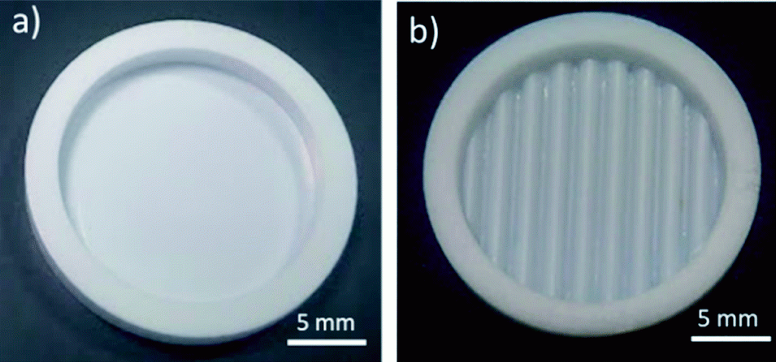
Ceramics can be a helpful material to compose various types of electrolyte-supported solid oxide cells. Traditionally, such SOECs (solid oxide electrolyser cells) have certain limitations in terms of physical shape and form. However, 3D printing allows designers to circumvent such hindrances and create new shapes that offer easy, custom energy solutions. Just as the image above shows, the cell on the right (developed by researchers at the Catalonia Institute for Energy Research) offers a corrugated form that allows for an increase of 57% in performance in fuel cell and co-electrolysis modes.
This mode of production isn’t just good at creating this one shape, but rather offers a model for the mass customization, rapid prototyping and the development of multiple different configurations that could be beneficial for energy saving devices. It was a radically new style of design that wouldn’t have been possible without additive manufacturing and its ability to create unconventional shapes quickly and easily.
Similarly, another test showed that SLA printing can create these corrugated structures, improving efficiency in both fuel cells and hydrolysis cells. The production on these experiments was done using the CERAMAKER by 3DCeram. The researchers anticipate a strong impact of these designs in “future generations of solid oxide cells and, more generally, in any solid-state energy conversion or storage devices”.
3D Printed Ceramic Medical Implants
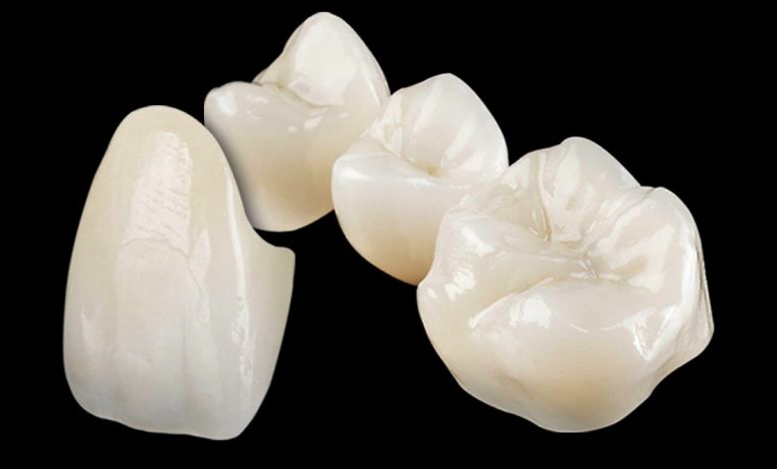
Image courtesy of Lithoz.
While all forms of 3D printing and the medical industry have had a prominent confluence, ceramic 3D printing provides unique advantages to multiple fields of healthcare. One such example comes from Admatec and CAM Bioceramics, who developed re-absorbable ceramics for developing bones. Using hydroxyapatite, Admatec and its partners can manufacture patient-specific, bioresorbable implants, which have defined pore structures and geometries. Using such bioceramics, they can also create far more complex channels, geometries, and lattice and honeycomb structures, imbuing implants and medical appliances with all sorts of mechanical properties.
Austria-based ceramic additive manufacturing company Lithoz has also been applying a lot of research time and funds to the development of dental products and implants. In this regard, not only are ceramics durable and maintain stability while possessing high mechanical performance, but 3D printing them has lower material wastage, improved customizability and greater design freedom. The ceramics companies Lithoz uses are also medically optimized, even though many are awaiting ISO certification.
Another example of ceramics in the medical field is that of micro-pillar arrays, which can be used as transducers for applications in medical imaging and non-destructive evaluation. These pillars are much easier to produce in this way and offer far better alternative shapes as compared to traditional manufacturing methods. The array’s main elements are usually designed with simpler geometries, such as cubes or rectangles, restricting potential applications. Mask-Image-Projection-based Stereolithography (MIP-SL) technology is particularly useful in producing such structures.
4D Printed Ceramics & Better Sensors
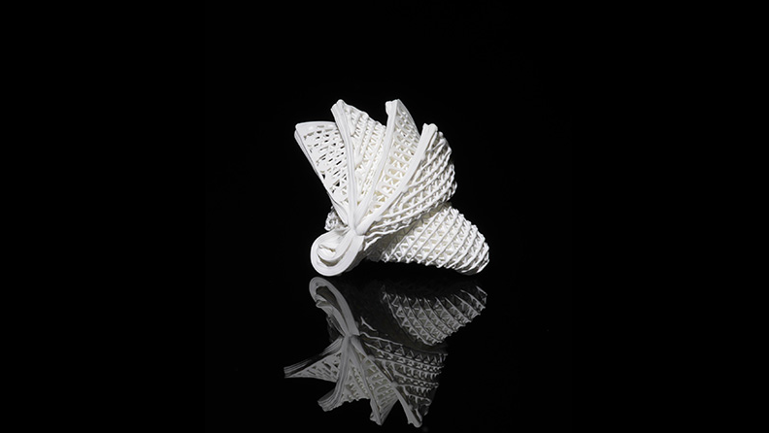
Ceramic printing has also seen a major growth in applications related to developing sensors of various types. These can be seen in industries as diverse as communication, 5G network development and even space travel. One such project came courtesy of City University Hong Kong and their work with 4D printed ceramics that can alter shape, properties and size in relation to external stimuli.
Aside from these mechanical properties, 4D ceramics have a low dielectric loss and can be designed with excellent thermal stability of dielectric properties. As a result, they tend to make for great electronics or sensors with the added advantage that it can be pretty easy to add metal components to them. They also bring with them a whole lot of magnetic and absorption properties. This even gives them a pretty decent potential as materials for cell phones and routers.
The Hong Kong team developed the ceramic as an extremely elastic substance that could be printed properly. The material itself uses mixture of ceramics and polymers, making its structure softer and malleable, yet having high durability. Such ceramics also have high temperature resistance in addition to all these desirable tensile capabilities. No wonder researchers see them as ideal for non-metal heating apparatuses and propulsion technology.
Researchers have also been using stretchable and durable ceramics to develop new types of piezoelectric electronics. These are useful in manufacturing sensors for acoustic imaging and energy harvesting, among many other applications. Such technologies run into obstacles with traditional manufacturing methods like etching and dicing, whereas 3D printing allows for complex geometries with high resolutions. Another major con for traditional manufacturing is that mechanical stress caused by the traditional machining processes can result in grain pullout, strength degradation and depolarization of certain aspects of the product, which will lead to significant degradation in piezoelectric device performance. Conversely, 3D printed designs of all sorts can be provided by manufacturers or rapid prototyping services at far better speeds with a lot less (if any) manual post-processing.
Ceramic Printed Optics

Transparent ceramics are widely used for optical equipment and 3D printed ceramics are making their way into this crucial industry. The main advantages that 3D printing brings into this particular production process are the improved automation and accuracy. Traditionally, producing optics has involved both manual and automated processes, therefore making it both laborious and prone to inaccuracies. This is not the case with additive manufacturing, which is bringing more speed and rapid prototyping to the table for 3D printed ceramic optics.
Additionally, making optics and mirrors with other methods like milling can waste up to 80% more material—along with the myriad common advantages AM brings like reduced weights, complex geometries and better lead times, this reduces costs and decreases risks incurred throughout the manufacturing process. Programs and processes like those developed by 3DCeram have allowed designers to customize their optics in all sorts of ways, producing novel new shapes.
Additionally, this also allows optics to be made from many sorts of ceramic materials, sometimes with a single machine. These materials can alter mechanical properties and give the optics different functions, from aerospace applications to high-energy lasers. Different materials can give an optical tool different mechanical and thermal properties, stiffness and density, among other characteristics.
There are also faster 3D printing methods, like ceramic or glass stereolithography, that can create such optics within five hours. These also offer the ability to hollow out sections, allowing for different function for the optic, making them useful for industries as diverse as biomedical, structural, or energy system applications, among many more. They can even create intricate internal structures that boost the strength without increasing weight.
It’s easy to see why more and more firms and institutions are turning to the use of new ceramic methods for the immense quality, time-saving and cost efficiency. All of these abilities are bringing ceramic printing to the forefront, showing off how much potential it has for industrial and medical applications.
https://3dprint.com/
 沪公网安备31011802004982